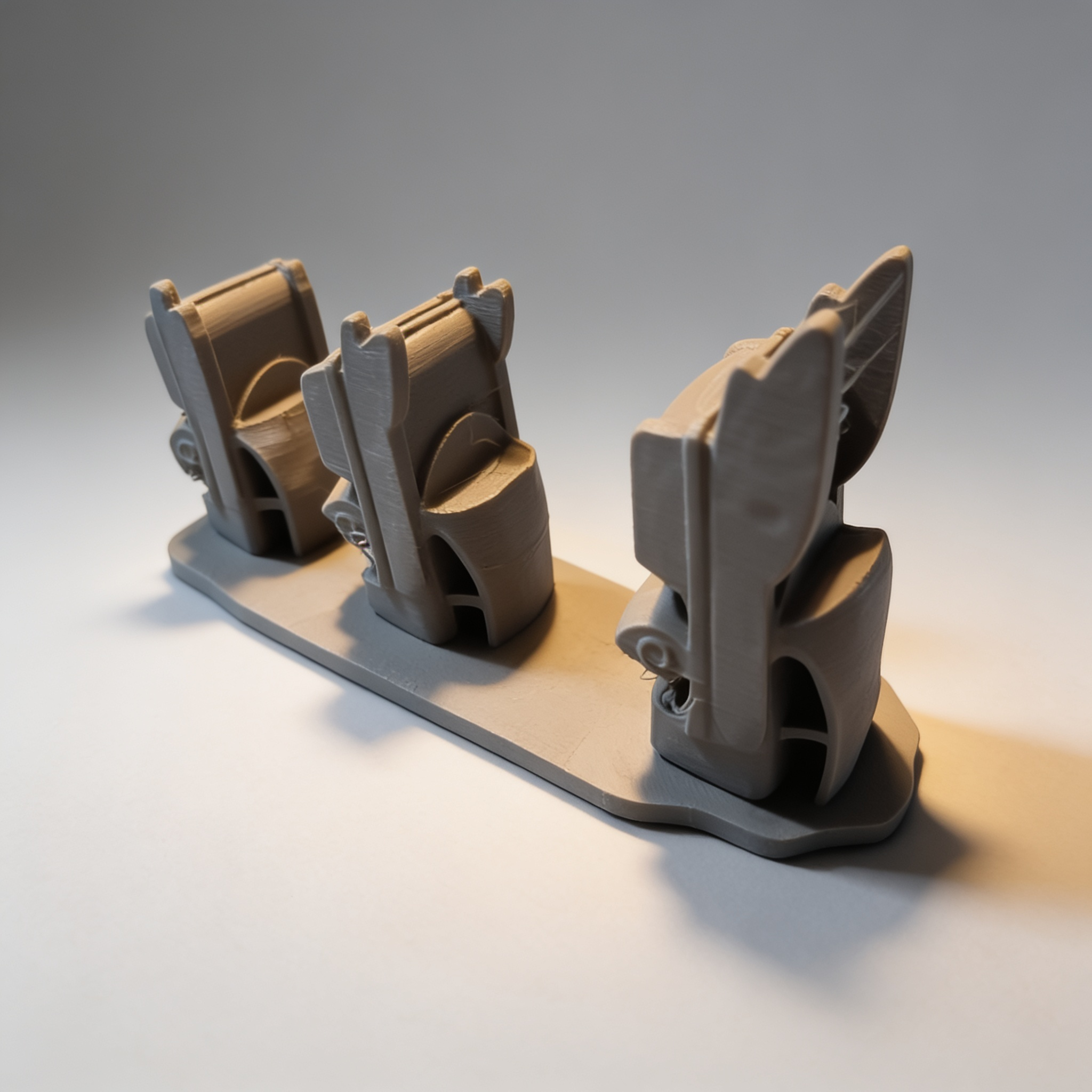
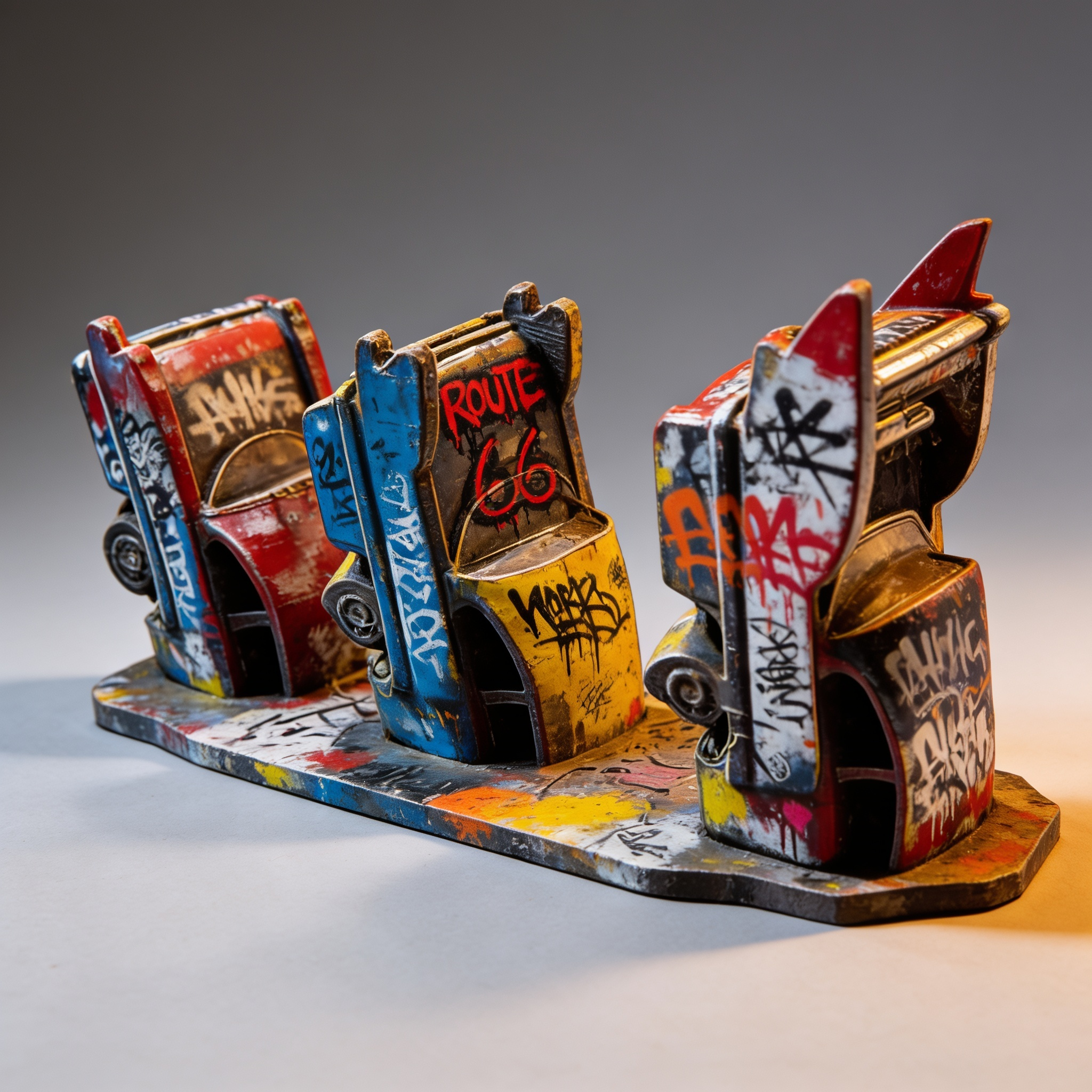
01This is not that story
Stand at the south end of the row and walk north, and read the cars in the order they were built — a 1949 Club Coupe at one end, a 1963 Sedan de Ville at the other, eight more strung between them. The artists who planted them in 1974 chose those years on purpose. They were not collecting Cadillacs. They were collecting tailfins.
The thirty years of overspray have turned the cars into something closer to coral. But the order never changed, and the order is the argument.
02The fin index
The tailfin did not exist before 1948. Harley Earl, head of design at General Motors, had seen the twin tails of a Lockheed P-38 fighter during the war and put a modest version on the back of the Cadillac. It was decoration. It did nothing. And it sold.
So the next year the fins were a little taller. And the year after that, taller again. Through the whole long boom of the 1950s the fins climbed, year over year, at every American automaker — not because anyone needed a fin, but because a bigger fin said next year will be better than this one, and in those years it always was.
They peaked in 1959. The 1959 Cadillac has the tallest tailfins ever bolted to a production car — twin bullet taillights, a piece of chrome shaped like optimism with nowhere to go. And then they fell. By 1963 the fin is an apology. By 1965 it is gone.
Walk the row and you are walking that line. Up through the fifties, the peak at the middle of the field, the long taper down. It is not a sculpture of cars. It is a chart.
03A fortune made of air
The man who paid for it knew that. His name was Stanley Marsh 3, and he was rich the way the Panhandle made men rich: gas, oil, and the air itself. Amarillo sat on top of the largest helium field on earth, and the fortunes built on what could be pulled out of this ground funded a great deal of strange and beautiful and eventually terrible things. Cadillac Ranch was one of the beautiful ones.
He hired an art collective from San Francisco called Ant Farm, gave them a field and a budget, and let them bury his cars. The legend is that the angle of the fins matches the slope of the Great Pyramid at Giza. The artists have always been coy about whether that is true. It does not matter. The point of a monument is the angle you choose to believe.
04The monument that moved
And here is the part the spray paint hides: the field you are standing in is not the original field. In 1997 the city of Amarillo had grown out far enough to reach the cars, so Marsh had all ten dug up and reburied two miles farther west — in the same order, at the same angles, facing the same way. The most authentic roadside relic in America was relocated, intact, to stay ahead of the city. Which is, when you think about it, the most Route 66 thing a monument could possibly do.
Everyone photographs the paint. The paint is the decoy. The thing in front of you is a fifteen-year record of a country's confidence — built, peaked, and tapered — paid for by a fortune pulled out of the same ground it stands on.
How a fighter plane's tail ended up on a luxury car. What Stanley Marsh 3 did with the rest of his fortune — and why Amarillo stopped saying his name. And the helium under your feet that paid for all of it.
05The tail that came from a warplane
Before the fins were buried in a wheat field, they were designed in a studio in Detroit by men who had spent the war watching aircraft. The 1948 Cadillac was the first postwar Cadillac. Harley Earl, GM's design chief, had been sketching cars since the twenties, but the look that defined the fifties — the look you are standing in front of — came from a different obsession entirely: the Lockheed P-38 Lightning.
Earl's team studied the twin-boom fighter's vertical stabilizers the way engineers study load charts. The P-38's tail was not decoration. It was structure — tall, sharp, unmistakable from a quarter mile. Earl put a version of that silhouette on a luxury sedan and called it progress. Within a decade every American car had fins. Within two decades they were gone. The buried row in front of you is a fossil record of that arc: from warplane to status symbol to punchline, compressed into fifteen model years and ten tail sections.
The spray paint is not vandalism. It is the second layer of the monument — the layer that admits the first layer was always going to need covering up.
06Who actually made this
Stanley Marsh 3 paid for Cadillac Ranch. He did not design it, build it, or bury the cars. That work belongs to Ant Farm — a San Francisco art collective formed by Chip Lord, Hudson Marquez, and Doug Michels in 1968. They were young, they were ironic, and they understood that American roadside culture was already a kind of sculpture. Marsh gave them a field, a budget, and permission to plant ten used Cadillacs nose-down at the angle of the Great Pyramid of Giza — or so the legend goes. The artists have never confirmed the pyramid math. They didn't need to. The angle was always belief, not measurement.
What Marsh understood — and what the tourists with spray cans do not — is that the cars were never the art. The art was the decision to bury them where the highway could see them, and then to let the highway rewrite them every morning.
07The name Amarillo stopped saying
Stanley Marsh 3 died June 17, 2014, under active felony indictment — eleven counts of sexual assault of minors. Before his death he had settled civil claims with more than ten underage plaintiffs for millions of dollars. The legal paperwork contains a line that tourism brochures have never quoted: "The parties agree that Stanley Marsh 3 does not own the Cadillac Ranch."
Amarillo did not tear the cars down. Amarillo moved them. In 1997 the city had grown far enough west that the original site — on private ranch land along Interstate 40 — sat inside the expanding footprint of suburban Amarillo. Marsh had all ten Cadillacs dug up, trucked two miles farther west, and reburied in the same order, at the same angles, facing the same direction. The most photographed roadside attraction in Texas was relocated intact to stay ahead of the city. Which is, when you think about it, the most Route 66 thing a monument could possibly do: keep moving west.
The spray paint covers the indictment. The relocation covers the ownership dispute. What remains is the graph — ten years of American confidence, buried nose-down in Panhandle dirt, paid for by a fortune that came out of the same ground.
08The air under the fins
Marsh's money was not oil money in the way most people imagine Texas oil money. It was helium money — the invisible extraction economy that made Amarillo the Helium Capital of the World. The Bush Dome formation beneath the Panhandle holds one of the largest helium reservoirs on earth. For decades the federal government ran a strategic reserve twelve miles northwest of downtown, purifying gas that would lift weather balloons, cool MRI magnets, and pressurize rocket fuel lines from Apollo to SpaceX.
The man who paid to bury these cars built his fortune on the same extraction logic that sold the world's helium supply to whoever needed it most — including, at various points, the same foreign powers whose engineering aesthetics ended up on the tailfins in front of you. The cars are a graph of confidence. The helium field beneath them is the graph's axis.