01A present, not an attraction
Hugh S. Davis ran the Tulsa Zoo. In retirement he did what zoo men do when nobody is stopping them: he built a private menagerie on his land outside Catoosa — a replica Noah's Ark, an alligator ranch, a pit of venomous snakes. He called it Nature's Acres. There was a spring-fed pond, and there were grandchildren, and the grandchildren wanted somewhere to swim.
His wife Zelta collected whale figurines. So Hugh started sketching a fish on the back of a napkin, and the fish kept growing until it was not a napkin sketch any more but full-size drawings on butcher paper of an animal eighty feet long. He called in a welder friend, Harold Thomas, who bent and burned the iron armature for free. Then Hugh mixed the concrete himself, one bucket at a time, and put it on by hand.
02It is life-size
This is the part visitors miss while they are photographing the smile: the Blue Whale of Catoosa is not a cartoon exaggeration of a whale. It is a whale. At eighty feet, Hugh Davis built to within arm's reach of the real animal's actual dimensions — the largest creature that has ever lived, laid out in concrete beside a two-lane road in Oklahoma.
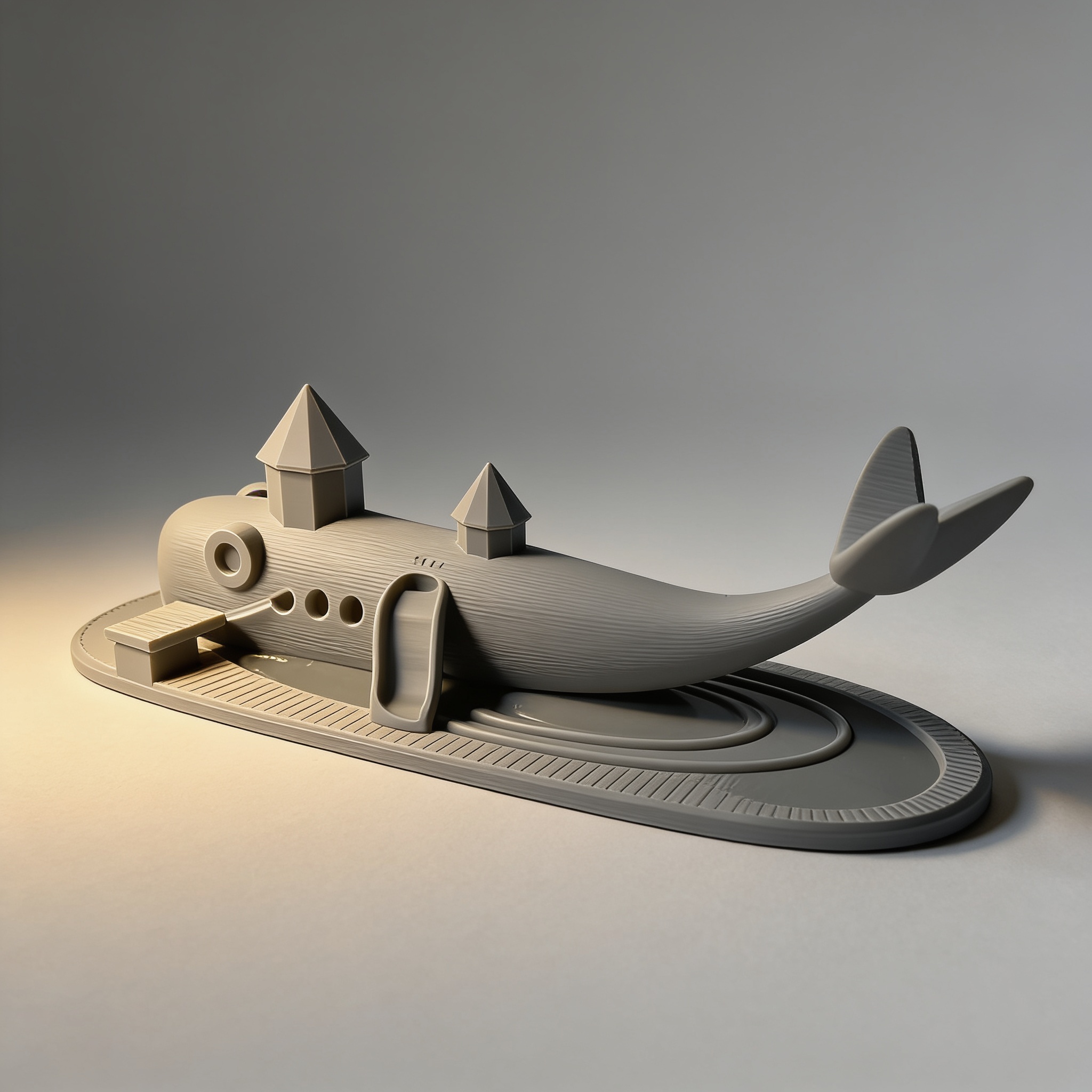
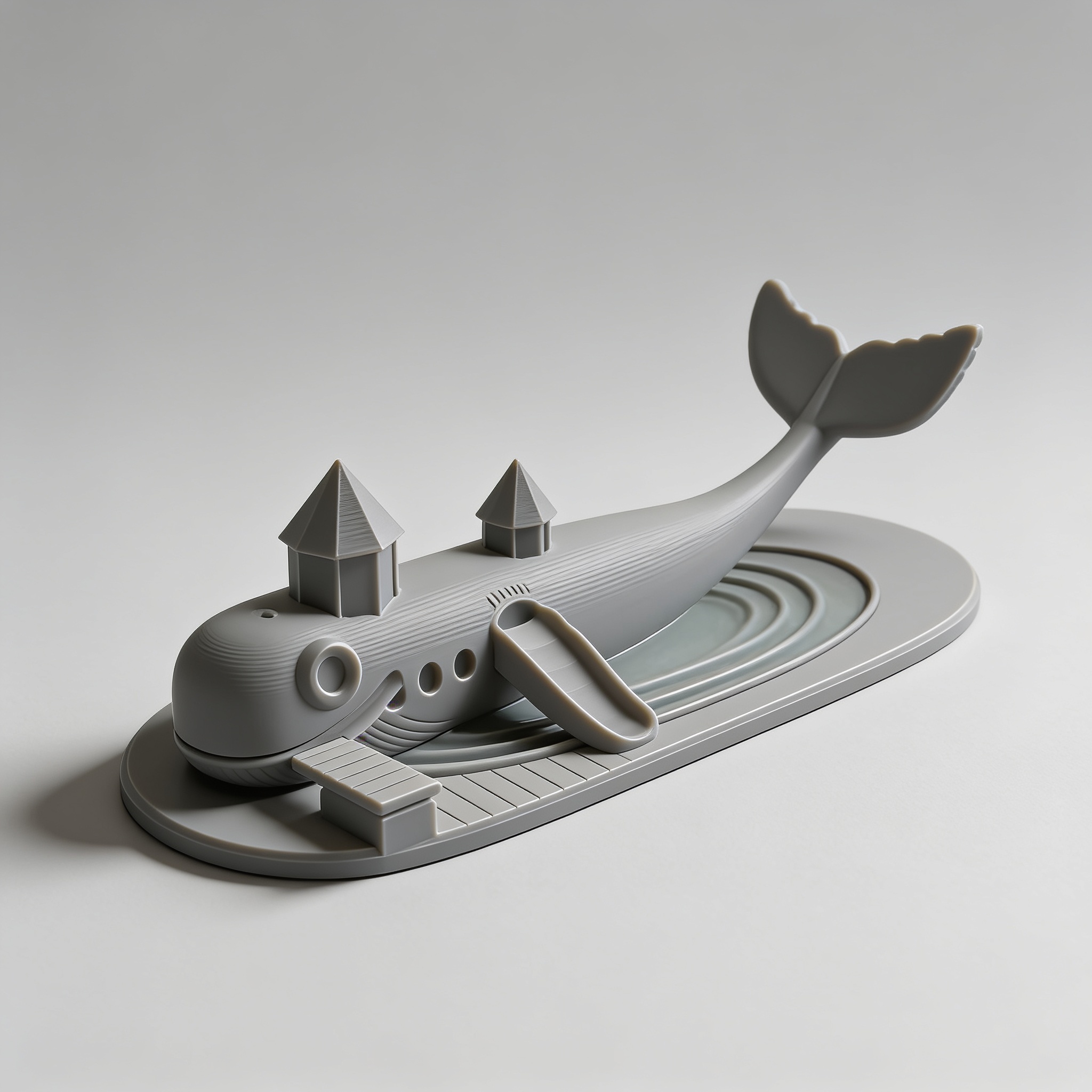
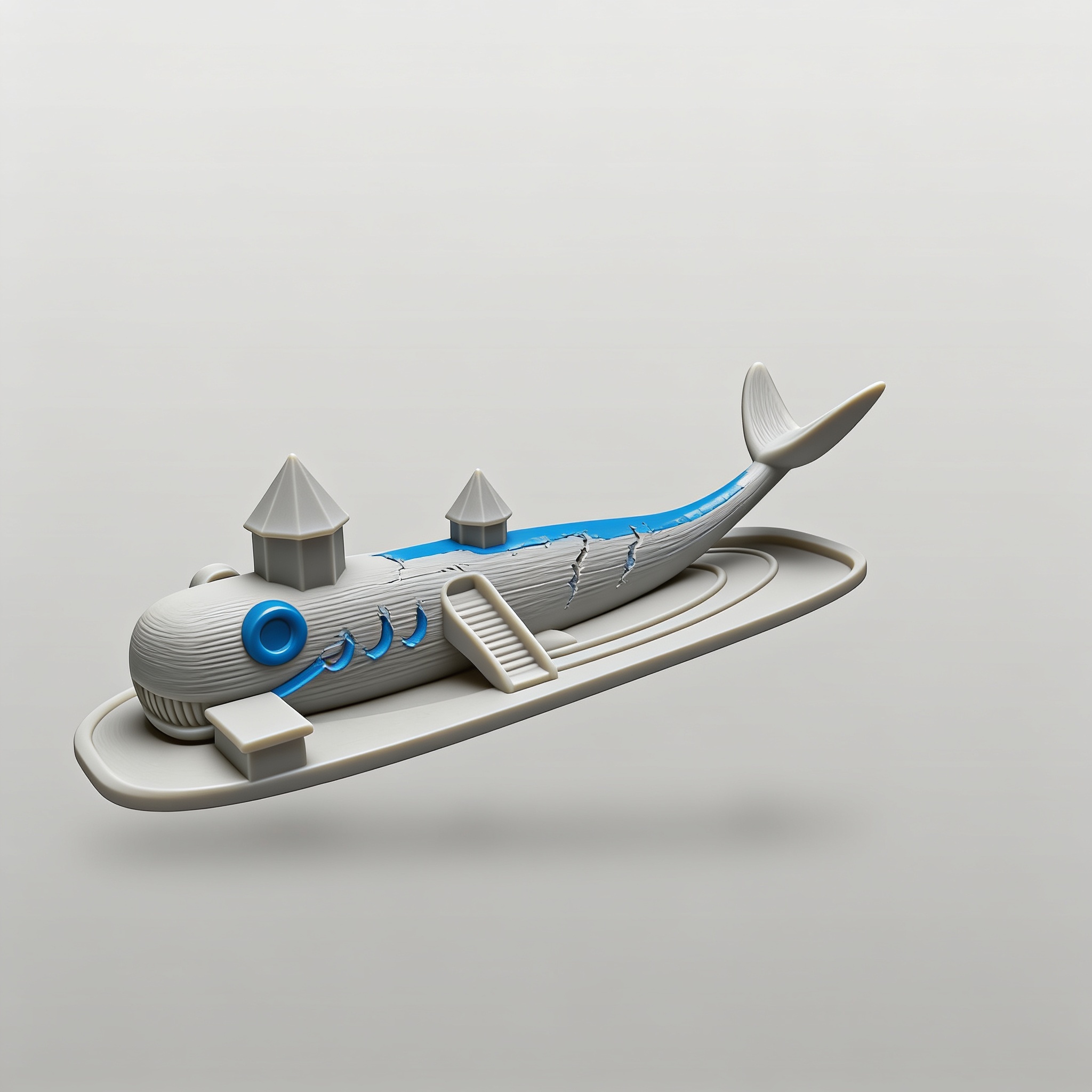
He built it to be climbed on, not looked at. The mouth is a doorway. There are portholes cut through the head. Where a whale has pectoral fins, Davis put water slides, and on the tail he poured a diving platform, because the point of the whole thing was to get children into the pond.
Everything about the Blue Whale is a piece of playground equipment wearing an animal costume. That is why it survived and the alligator ranch did not.
03Why it is blue
Hugh wanted to paint it black and white, like a killer whale. Zelta said no. Her reason, as she remembered it later, was four words long: "We don't have mean things."
So the most photographed roadside animal in Oklahoma is blue because of a veto. He presented it to her on the seventh of September, 1972 — their thirty-fourth wedding anniversary. By then people had already started pulling off the road to look at it, and in July the Davises had given up and opened the gate.
Almost every roadside attraction in America was built to catch a car. This one was built to catch a wife's eye, and the cars caught it by accident. The difference is visible in the object: nobody puts a diving platform on a billboard.
The arithmetic of building something by hand: 2,920 hours against $1,783 of material, and what that ratio says about every monument on the Mother Road. What happened to the whale after Hugh died. And why the town ended up owning it.
04The ledger nobody reads
Two numbers survive from the build, and put side by side they explain the entire economics of the American roadside. The material bill was $1,783, priced in 1969 dollars. The labor was 2,920 hours.
Spread across the two years Hugh spent on it, 2,920 hours is roughly twenty-eight hours a week — a second job, every week, for a hundred and four weeks, in Oklahoma weather, at sixty years old. Harold Thomas donated the welding. Nobody was paid. There was no budget line for labor because there was no labor market involved; there was a man who wanted to give his wife something and had time instead of money.
That is the ratio that built Route 66's best objects and the reason they cannot be reproduced. A contractor quoting the same whale today would price the hours first and the concrete last, and the number would kill the project in the first meeting. The Blue Whale exists because the most expensive input was donated by someone who did not consider it an input.
Every hand-built monument on the Mother Road is a labor subsidy from one obsessive person to everyone who drives past afterward.
05What happened after
Hugh Davis died in 1990. The pond stopped being a swimming hole. Nature's Acres was already gone — the ark, the gators, the snakes, all of it folded back into pasture. What was left was eighty feet of concrete in water that nobody was maintaining, and concrete in water does exactly what you would expect. The paint went. The steel underneath started to show.
It came back the way these things come back: not through a preservation grant but through people from the town showing up with brushes. The whale got repainted. The grass got cut. The gift shop reopened. Today swimming is prohibited — the pond is for fishing and for feeding the turtles — and the site is looked after as a Catoosa landmark rather than as somebody's back yard.
Which closes the loop in a way Hugh probably would have found funny. He built a private object for one person. It got adopted by strangers, neglected, rescued by strangers again, and finally taken on by the town as public property. The whale outlived the family, the attraction, and the highway's own heyday, and it is still smiling in the same direction.
06The thing you are actually looking at
Stand at the walkway and read the object as a set of decisions. The mouth is open because a door had to be a mouth. The head has portholes because a child inside a dark concrete whale needs to see out. The fins are slides because fins were the only place a slide could go. The tail is flat on top because you cannot dive off a fluke.
None of it is sculpture in the sense that Cadillac Ranch is sculpture — there is no argument being made, no irony, no art collective. It is a very large toy, engineered backwards from what a seven-year-old wants to do in a pond, and then painted the color his wife asked for. That is the whole brief. It has been enough for fifty years.